Strawberries and candy get all the attention in the freeze drying community, and honestly, that makes sense — they are visually stunning, easy to share online, and beginner-friendly. But if you really want to unlock the full potential of your home freeze dryer and build a serious long-term food supply, meat is where things get genuinely powerful.
Freeze dried meat is one of the most valuable things you can put in your food storage. It is lightweight, calorie-dense, protein-rich, and when done correctly, it can sit in a sealed mylar bag for up to 15 to 25 years without refrigeration. Think about what that means: your own home-produced chicken, beef, and ground meat, shelf-stable and ready to throw into any meal without a single trip to the store.
But meat also comes with considerations that fruits and vegetables do not. Safety matters here. Fat content matters here. Getting these right separates a successful long-term batch from a wasted cycle that goes rancid in two years. This guide walks you through everything in plain, practical detail — no shortcuts, no hand-waving.
Best meats to freeze dry: Cooked lean chicken breast, extra-lean ground beef (96/4), diced steak, turkey | Cycle time: 30 to 40 hours | Shelf life: 15 to 25 years (mylar + oxygen absorbers) | The one rule: Always cook first. Always trim the fat.
Raw vs. Cooked: The Question Everyone Asks First
Before anything else, let us address the question that fills every freeze drying forum thread: can you freeze dry raw meat?
Technically, yes. A freeze dryer does not care whether meat is raw or cooked when it enters the chamber. The machine will run a cycle, sublimate the moisture, and produce a dried product either way.
But here is the reality from a practical home use standpoint: you should always freeze dry cooked meat. Here is why that matters for everyday home users in the USA:
- Food safety: Raw chicken and raw beef carry pathogens like Salmonella, E. coli, and Campylobacter. The freeze drying process does not reach high enough temperatures to kill bacteria — it works at very low temperatures throughout. Cooking first eliminates these pathogens before they ever go near your machine.
- Rehydration quality: Cooked freeze dried meat rehydrates much more reliably than raw. Raw freeze dried meat can produce an odd, mushy texture when water is added back. Cooked and freeze dried chicken, for example, rehydrates to something very close to its original texture when you add it to hot soup or stew.
- Cross-contamination risk: Running raw meat through your freeze dryer requires thorough decontamination of trays, the chamber, and all seals afterward. For home users running mixed food batches, this creates a contamination management challenge that most people underestimate.
- Practical shelf life: Cooked lean meat simply stores better and more safely long-term than raw. The cooking process denatures proteins in ways that affect how the food behaves in storage.
Always cook all poultry to a minimum internal temperature of 165°F and all ground beef to 160°F before freeze drying. Use a reliable instant-read thermometer — do not guess. This is a food safety non-negotiable, not a preference.
The Fat Rule: The Single Most Important Thing You Will Learn Today
If there is one thing this entire article needs to communicate clearly, it is this: fat is the enemy of freeze dried meat shelf life.
Fat does not sublimate during freeze drying. While moisture converts from ice to vapor and gets captured by the cold trap, fat simply stays in the food exactly as it was when you loaded the tray. And that leftover fat will eventually go rancid — the technical term is lipid oxidation — producing off-flavors, unpleasant smells, and ultimately making the food unsafe to eat.
This is the reason you hear experienced freeze dryers talk obsessively about using 96/4 extra-lean ground beef, buying boneless skinless chicken breast rather than thighs, and aggressively trimming every visible white fat deposit off a steak before it goes anywhere near the machine.
Here is how fat content affects real-world shelf life for freeze dried meat:
| Meat Type | Fat Level | Estimated Shelf Life | Notes |
|---|---|---|---|
| Chicken breast (skinless) | Very Low | 20 to 25 years | Best overall for long-term storage |
| Extra-lean ground beef (96/4) | Very Low | 15 to 20 years | Rinse cooked crumbles under hot water to remove residual fat |
| Lean diced steak (trimmed) | Low to Medium | 10 to 15 years | Aggressive fat removal required before freeze drying |
| Turkey breast (cooked) | Very Low | 20 to 25 years | Similar to chicken breast, excellent choice |
| Regular ground beef (80/20) | High | 2 to 5 years | Not recommended — fat goes rancid rapidly |
| Pork sausage / bacon | Very High | Less than 1 to 2 years | Avoid entirely for long-term freeze drying |
The practical takeaway is simple. The leaner the meat, the longer it lasts. Stick to chicken breast, extra-lean ground beef, and well-trimmed lean cuts of beef for anything intended for long-term storage. Save the fattier cuts for meals you plan to freeze dry and rotate through within a year or two.
Best Meats to Freeze Dry at Home: A Practical Guide
Cooked Chicken Breast
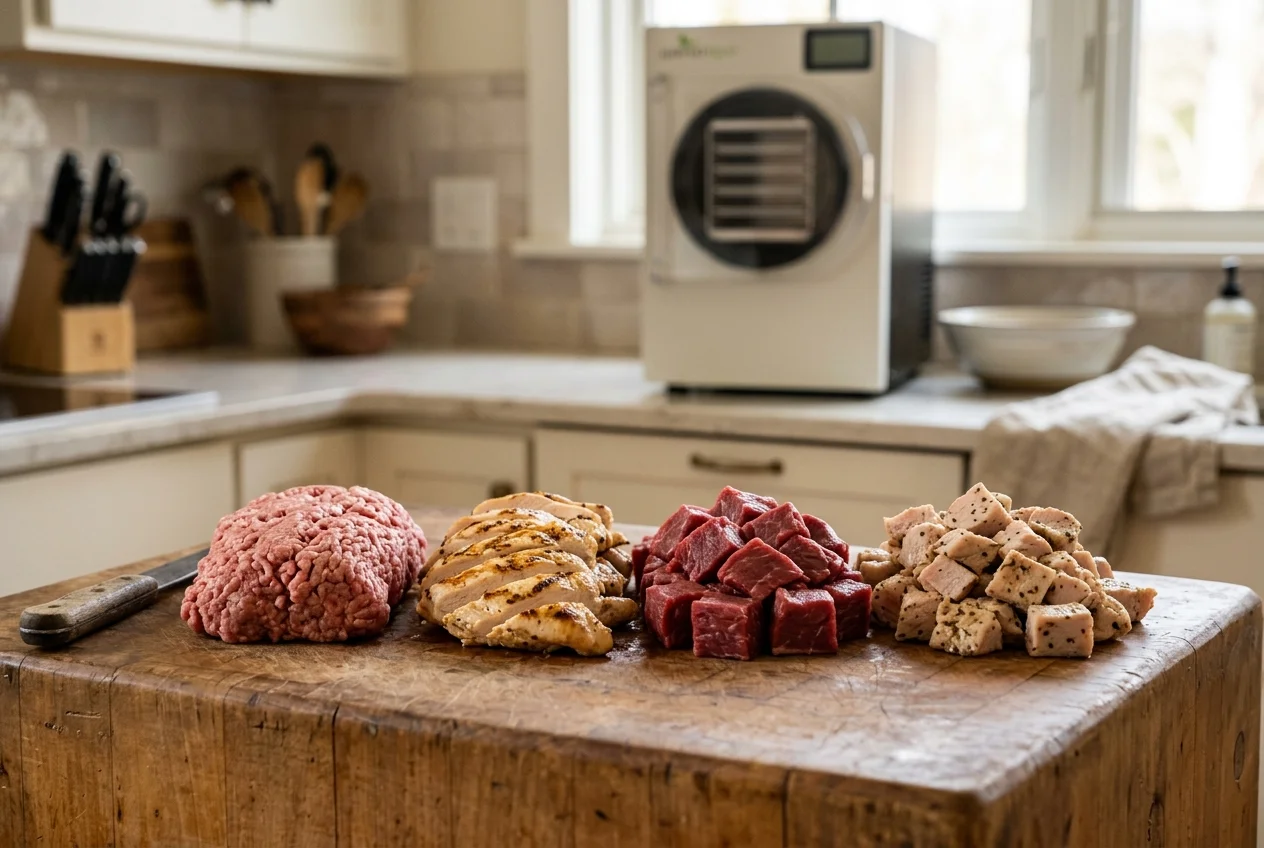
Chicken is the single best meat for home freeze drying. The reasons are simple: it is naturally lean, it cooks quickly, it shreds or dices easily, it rehydrates beautifully, and it tastes great in almost any dish after it comes out of storage. Whether you poach it, bake it, or pressure cook it, cooked chicken breast produces consistent, excellent freeze dried results.
For best results, cook your chicken breast plain with minimal oil or fat. Season lightly if you like — salt, pepper, and garlic all freeze dry well. Cut into half-inch cubes or shred after cooking. Pre-freeze on trays and load into the machine. Expect 28 to 34 hours cycle time.
When you eventually rehydrate freeze dried chicken in hot water, soup broth, or a stew, it comes back to a texture that is impressively close to freshly cooked chicken — something that genuinely surprises people trying freeze dried home-cooked meat for the first time.
Extra-Lean Ground Beef
Ground beef is one of the most popular freeze dry projects for homesteaders and preppers across the USA because it is versatile, affordable when bought in bulk, and stores extremely well in lean form.
The key is to buy 96/4 or 93/7 extra-lean ground beef — not the standard 80/20. Cook it completely until fully browned, breaking into fine crumbles as you go. Here is a step that most beginner guides skip: once cooked, transfer the ground beef crumbles into a colander and rinse under hot running water for 30 to 60 seconds. This removes a substantial amount of residual surface fat that cooking alone does not eliminate, and it directly extends your shelf life by years.
Pat dry with clean paper towels after rinsing, spread evenly on freeze dryer trays, and pre-freeze before loading. Expect 26 to 34 hours cycle time. Finished ground beef crumbles will look similar to dried bread crumbs — lightweight, hard, and fully dry throughout.
Diced Lean Beef Steak
Lean cuts like sirloin, eye of round, or top round are excellent choices for freeze drying when trimmed aggressively. Avoid cuts with heavy marbling (like ribeye) — that intramuscular fat will not dry out and will limit shelf life significantly.
Cook your steak to well-done, not medium-rare. For freeze drying purposes, you want as much moisture cooked out of the meat as possible before it even enters the machine. Medium-rare steak is wonderful at dinner but produces inconsistent results in a freeze dryer. Dice into uniform three-quarter inch cubes after cooking and trim any visible white fat deposits before loading trays.
Cooked Turkey Breast
Turkey is perhaps the most underrated freeze dry meat choice. Turkey breast is extremely lean, widely available, and can often be purchased in large quantities post-Thanksgiving at very low per-pound costs. Diced cooked turkey breast freeze dries with a texture and rehydration quality nearly identical to chicken. It is an excellent choice for building a diverse protein rotation in your food storage.
Step-by-Step: How to Freeze Dry Meat at Home
Step 1: Cook Thoroughly to Safe Temperatures
Cook all meat fully before it ever gets near the freeze dryer. Use an instant-read thermometer to confirm safe internal temperatures. For poultry (chicken and turkey), that means a minimum of 165°F measured at the thickest part. For ground beef, 160°F throughout. For whole cuts of beef like steak, 145°F minimum — though going to well-done is better for freeze drying purposes as mentioned above.
Season your meat lightly if desired. Salt and most dried spices handle the freeze drying process well. Avoid sauces or marinades with high sugar or oil content — these can interfere with drying and dramatically reduce shelf life.
Step 2: Trim All Visible Fat
After cooking, while the meat is still warm and the fat is visible, go through every piece and remove all white fat deposits you can see or feel. Use sharp kitchen shears or a paring knife. This step is not about being obsessive — it is about protecting the investment of time and food you are putting into every batch.
For ground beef specifically, the hot-water rinse method described earlier is your best tool here. For diced chicken and steak, visual and tactile inspection of each piece before loading is the most effective approach.
Step 3: Cut Into Uniform Pieces
Uniform size is critical for even drying. If some pieces are twice the size of others, the smaller pieces will finish drying while the large ones still retain moisture in the center. Aim for half-inch to three-quarter inch cubes for most cooked meats. Shredded chicken can go on trays as-is without cutting.
Step 4: Pre-Freeze on Trays
Arrange meat in a single layer on your freeze dryer trays. Do not stack pieces. Load the trays into your regular household freezer for at least 4 to 6 hours — or overnight if your schedule allows. Pre-frozen meat enters the freeze dryer already at the right temperature, skipping the machine's initial freeze phase and reducing your total cycle time by 2 to 4 hours per batch.
Step 5: Load and Run the Cycle
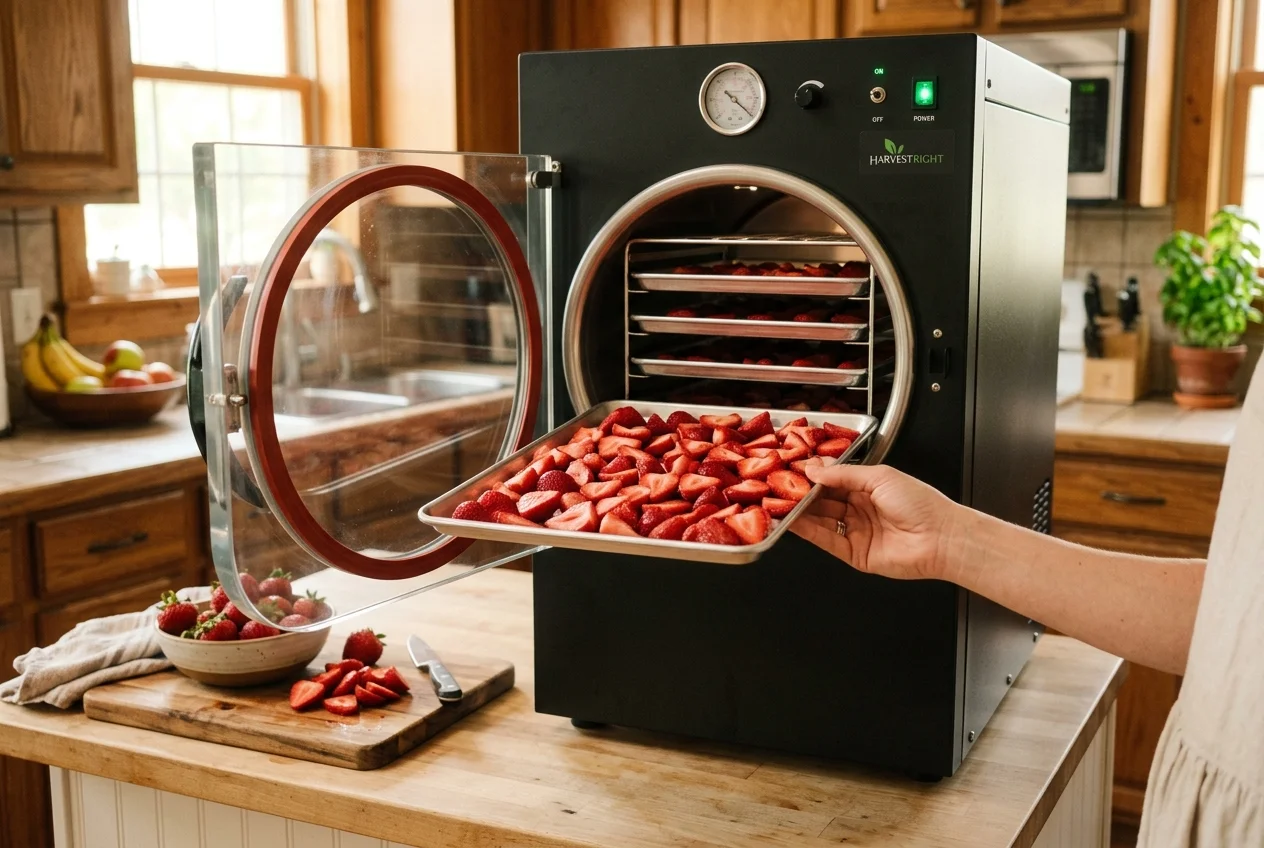
Remove the pre-frozen trays from your household freezer and load them into the freeze dryer quickly. Close and latch the door and press Start. The Harvest Right and similar home machines handle the rest automatically, monitoring chamber temperature and vacuum pressure throughout the cycle.
For cooked meat, expect significantly longer cycle times than fruits or vegetables. The dense protein structure of meat releases moisture more slowly than plant-based foods. A typical cycle for cooked chicken or ground beef runs 30 to 40 hours. Do not be alarmed if your machine runs longer — this is normal for protein-heavy batches, especially with thick pieces or very full tray loads.
Step 6: The Dryness Test
When your machine signals the cycle is complete, pull a piece from the center of the middle tray and test it. Properly freeze dried cooked meat should be:
- Completely hard and dry throughout — no rubbery, soft, or pliable sections anywhere
- Very light for its size — significantly lighter than the cooked piece you started with
- Crunchy when you bite it, almost like a crouton in texture
- Free of any moisture or greasiness on the surface
If any piece feels soft, chewy, or pliable in the center, return all trays to the machine immediately and run an additional 3 to 5 hour extended cycle. Meat especially benefits from this caution — residual moisture in sealed protein is a more serious food safety concern than residual moisture in fruit.
Step 7: Package Within 10 Minutes
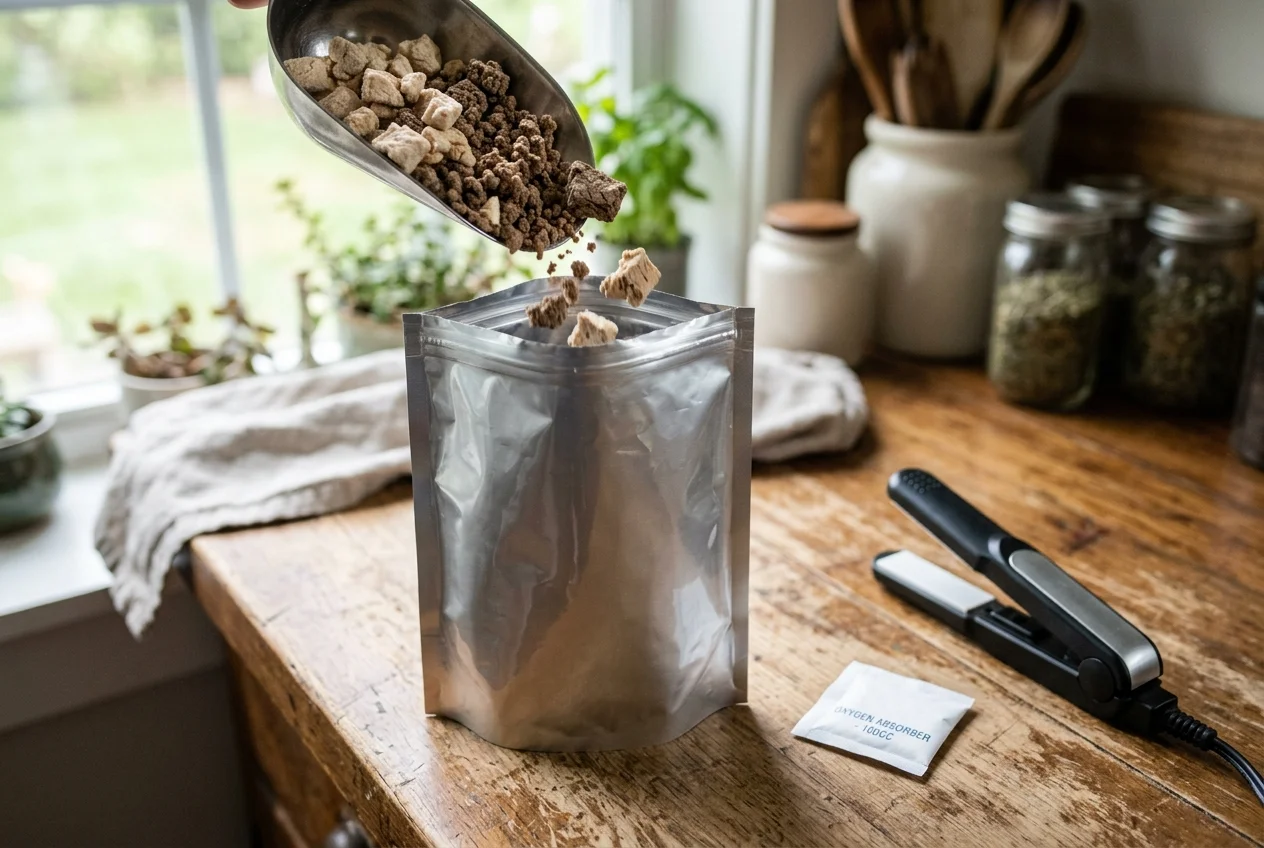
Freeze dried meat is hygroscopic just like all freeze dried food — it will begin pulling moisture from the air the moment the chamber is opened. Have your packaging materials fully prepared and laid out before you open the freeze dryer door. The packaging process for meat should take no more than 10 to 15 minutes from opening the machine to sealed bag.
Use 7-mil mylar bags — not vacuum-seal bags or thin mylar. Add a 300cc oxygen absorber for 1-gallon bags or a 2000cc absorber for 5-gallon bags. Heat seal twice and test the seal by tugging both sides firmly. Label every bag with the meat type, cook date, freeze dry date, and estimated use-by year.
Storage Guide for Freeze Dried Meat
| Storage Method | Expected Shelf Life | Best For |
|---|---|---|
| 7-mil mylar bag + 300cc oxygen absorber + 55 to 70°F dark storage | 15 to 25 years | Long-term emergency food storage |
| Vacuum-sealed mason jar + oxygen absorber | 2 to 4 years | Regular rotation pantry stock |
| Airtight container at room temperature | 3 to 6 months | Active weekly cooking use |
| Open air / uncovered | Hours | Immediate consumption only |
How to Rehydrate Freeze Dried Meat
The rehydration process for freeze dried meat is straightforward, but a few tips will get you much better results than just pouring water on it and hoping for the best.
- Hot water or broth works best. Cold water rehydrates meat slowly and unevenly. Use hot water (just off the boil) or heated chicken broth for chicken, or beef broth for ground beef and steak. The heat accelerates moisture absorption and produces a better final texture.
- Use the right ratio. A general starting point is 1 part freeze dried meat to 1.5 to 2 parts water by volume. Exact ratios vary by meat type and cut size — chicken crumbles need less water than diced steak chunks. Add liquid gradually rather than dumping everything at once.
- Give it time. Most freeze dried meat rehydrates fully in 5 to 15 minutes when submerged in hot liquid. Denser pieces like steak cubes may need 15 to 20 minutes. For cooking in a pot or slow cooker, you can add freeze dried meat directly to the liquid and let it rehydrate as the dish cooks — this is the most convenient method for soups, stews, and chilis.
- Add directly to recipes. Freeze dried ground beef crumbles can go directly into a simmering pot of chili, pasta sauce, or taco filling. They rehydrate within minutes from the recipe's own liquid. This is one of the biggest practical advantages of freeze dried meat over other preservation methods.
Many experienced freeze dryers cook full meals — chili, beef stew, chicken soup, turkey rice bowls — and freeze dry the complete dish rather than individual ingredients. Full meals rehydrate with all their flavors intact and make the fastest possible emergency meals. Simply add hot water, stir, and eat. No cooking required at all.
The Real Cost Savings of Freeze Drying Your Own Meat
Commercial freeze dried meat is expensive — genuinely eye-watering when you price it out per serving. A single can of Mountain House or Augason Farms freeze dried chicken typically runs $18 to $30 for what amounts to 4 to 6 servings. A full year of freeze dried meat for a family of four at those commercial prices would cost several thousand dollars.
When you freeze dry at home, you pay for the fresh meat (or buy in bulk when it goes on sale), the electricity for the cycle (roughly $1.50 to $3.00 per batch), and the packaging supplies. A two-pound batch of cooked chicken breast from a store sale might cost $5 total to produce as freeze dried chicken — versus $20 or more for a comparable commercial can. Over time, that math becomes very compelling, especially if you buy meat in bulk at Costco, Sam's Club, or when your grocery store runs manager specials on proteins approaching their sell-by date.