One of the first questions almost every new freeze dryer owner asks — right after "is this machine really worth the price?" — is: how long does freeze dried food actually last?
You've probably seen claims ranging from 10 years all the way up to 25 or even 30 years, and honestly, it's easy to feel a little skeptical about the higher numbers. Can a strawberry really sit in a bag for two decades and still be edible? The short answer is yes — but only if everything is done right. And that's exactly what we're going to dig into today.
This guide breaks down real, practical shelf life numbers for every major food category, explains the science behind why freeze dried food lasts so long, and — most importantly — shows you what factors can cut that shelf life down dramatically if you're not careful.
Properly sealed freeze dried fruits and vegetables can last 25–30 years. Cooked meats last 15–25 years. Dairy products and full meals typically fall in the 15–20 year range. But these numbers assume ideal packaging and storage — and that's where most people fall short.
Why Does Freeze Dried Food Last So Long?
To understand the shelf life, you first have to understand what freeze drying actually does to food at a microscopic level. When food spoils, it's almost always because of one (or more) of three things: moisture, oxygen, or heat.
Freeze drying removes roughly 98–99% of a food's moisture content through a process called sublimation — where ice crystals convert directly into vapor without ever becoming liquid first. This happens inside a vacuum chamber at extremely low temperatures, which is what makes the process so effective at preserving food structure.
No moisture means bacteria, yeast, and mold have nothing to work with. They simply cannot grow. Enzymes responsible for food degradation cannot function. Oxidation slows to a near stop when you pair the dry food with oxygen absorbers in your packaging. And if you store everything in a cool, dark place, you've essentially eliminated all three major spoilage drivers at once.
That's the science in plain English. Now let's look at actual shelf life numbers by food type — because not everything lasts the same amount of time, and knowing the differences matters for planning your food storage.
Freeze Dried Food Shelf Life by Category
Every food type has a different natural water content, fat content, and protein structure — and these biological differences affect how long the food lasts once it's been freeze dried. Here's a breakdown you can actually use for planning:
| Food Type | Common Examples | Shelf Life (Ideal Storage) | Key Notes |
|---|---|---|---|
| Fruits | Strawberries, apples, blueberries, bananas, peaches | 25–30 years | Low fat content = excellent longevity |
| Vegetables | Peas, corn, carrots, spinach, green beans | 25–30 years | One of the best categories for long-term storage |
| Cooked Meats | Chicken, ground beef, diced steak, turkey | 15–25 years | Fat content in meat shortens shelf life |
| Raw Meat | Raw chicken, raw beef | 10–15 years | Higher risk; cooked is always recommended for home use |
| Dairy | Cheese, butter, milk, eggs, ice cream | 15–20 years | Fat reduces longevity; high-fat items last shorter |
| Complete Meals | Soups, stews, casseroles, pasta dishes | 15–20 years | Depends on fat and protein content of ingredients |
| Herbs & Spices | Basil, oregano, chives, parsley | 5–10 years | Flavor degrades faster than safety; still safe but less flavorful |
| Candy & Sweets | Skittles, gummies, marshmallows | 10–15 years | Sugar-based; moisture and heat can cause clumping over time |
These are maximum shelf life estimates under ideal conditions. In real-world home storage — especially in warmer parts of the USA like the South or Southwest — the actual usable life is often 20–30% shorter. The next section explains what actually drives these differences.
The 4 Factors That Actually Determine Shelf Life
Here's the truth a lot of freeze drying guides gloss over: the "25-year shelf life" claim is technically accurate, but it assumes everything was done perfectly. Most people — even experienced freeze dryers — don't hit perfect conditions every single time. Understanding these four variables gives you real control over your food's longevity.
1. Storage Temperature — The Single Biggest Variable
Temperature has a more dramatic impact on shelf life than almost any other factor. Every 10°F increase in storage temperature roughly doubles the rate at which food degrades. That means food stored in a 80°F garage deteriorates twice as fast as the same food kept at 70°F.
Here's how temperature zones break down in practical terms:
- 55–65°F (ideal): Maximizes shelf life. Aim for a cool basement, interior closet, or climate-controlled pantry.
- 65–75°F (acceptable): Slight reduction — most home pantries fall here, which is fine for most purposes.
- 75–85°F (degraded): Meaningful reduction, especially for meat and dairy. Avoid uninsulated spaces during summer.
- Above 85°F (poor): Shelf life can drop by 40–50%. Never store freeze dried food in a hot garage, attic, or vehicle.
2. Oxygen Inside the Package
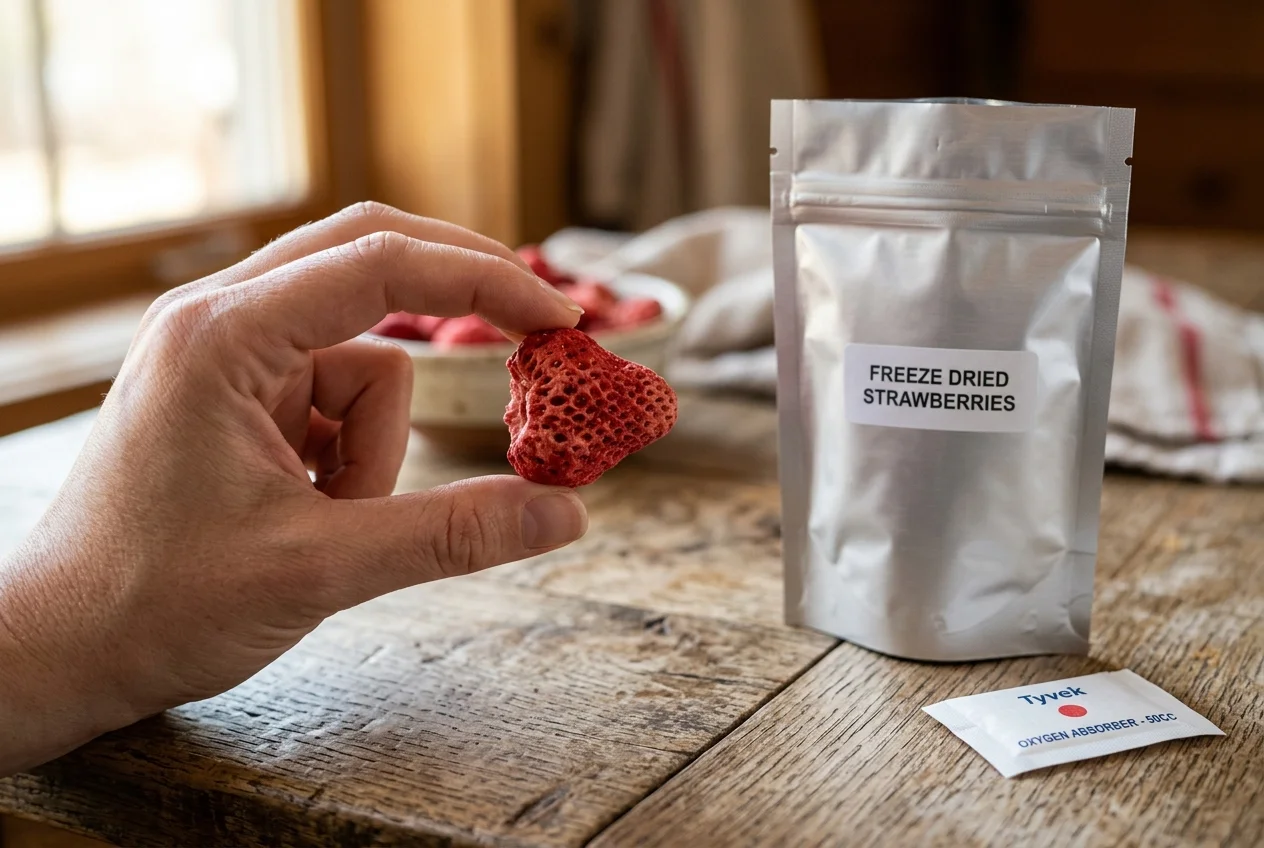
Oxygen is the quiet destroyer of stored food. Even at cool temperatures, residual oxygen inside a sealed bag will slowly oxidize fats and degrade flavors over the years. This is why oxygen absorbers are not an optional extra — they're essential for any long-term storage beyond a year or two.
For mylar bags, use 300cc oxygen absorbers for quart-sized bags and 2000cc absorbers for gallon or larger bags. Once sealed, the oxygen level inside drops below 0.1% — far too low for any meaningful spoilage activity.
3. Your Packaging Choice
Not all storage containers perform equally over decades. Here's how the most common options compare:
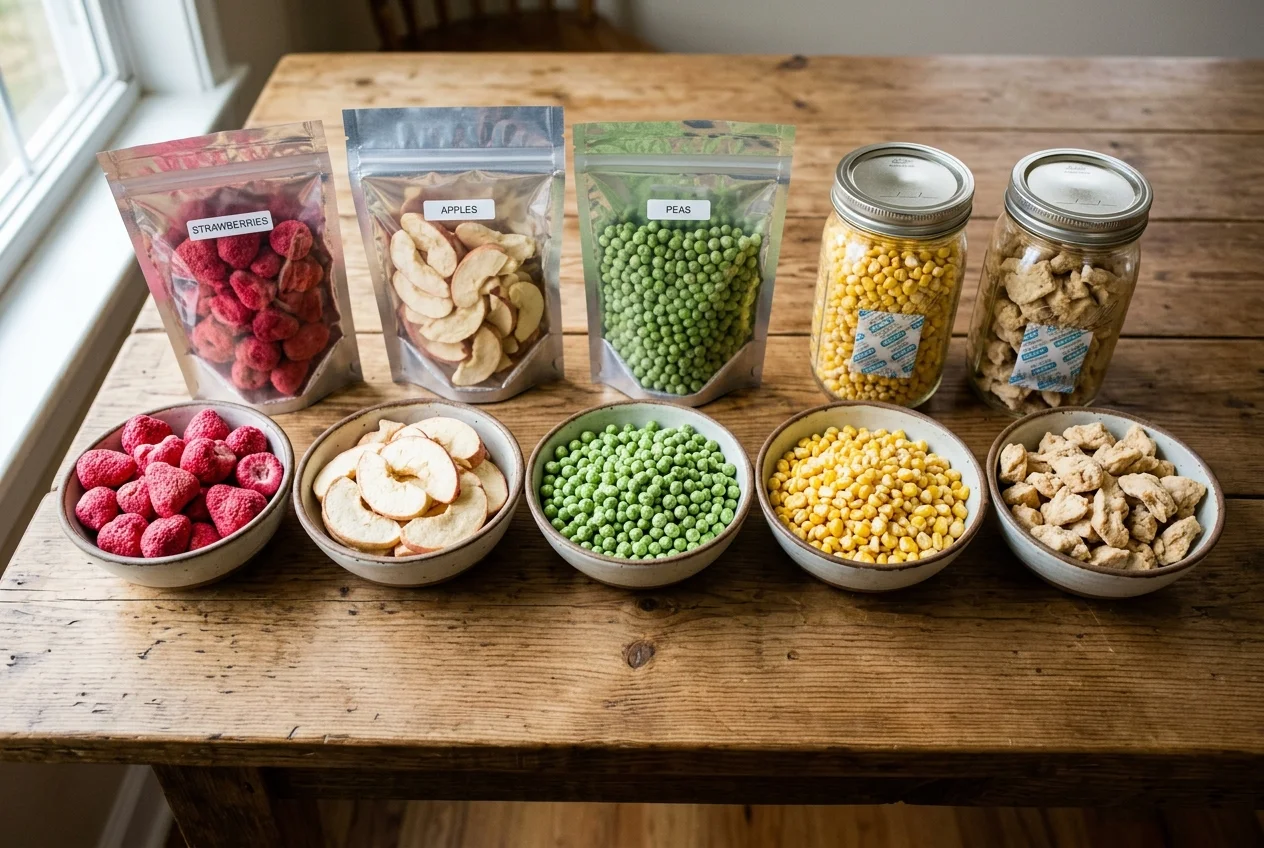
- Mylar bags with oxygen absorbers: The gold standard for 20+ year storage. Blocks light, moisture, and oxygen completely.
- Mason jars with oxygen absorbers: Excellent for 1–5 years. Easy to inspect. Glass is moisture-proof but not light-proof — store in a dark location.
- Vacuum-sealed bags: Good for 1–3 years. Insufficient for very long-term storage since some oxygen permeation occurs over time.
- Zip-lock or regular plastic bags: Fine for days or weeks only. Never use for serious long-term storage.
4. Light Exposure
UV light degrades vitamins and certain nutrients even through some packaging materials. Always store sealed bags in a dark location — inside a cardboard box, a closed pantry, or purpose-built shelving away from any window exposure. Mylar naturally blocks light, but keep it away from direct sunlight regardless.
Home Freeze Dried vs. Commercial — Is There a Real Difference?
This question comes up constantly in the freeze drying community, and it's a fair one to ask before investing in a Harvest Right machine. Commercial freeze dried food — the kind sold by Mountain House, Augason Farms, or Thrive Life — is processed in industrial machines that reach lower temperatures and deeper vacuum levels than home units.
In theory, this means slightly more complete moisture removal. In practice, the difference is genuinely small. A well-run Harvest Right batch with careful technique will produce food that's very close to commercial quality in terms of moisture content and nutritional preservation.
Where home freeze drying can fall behind is in the sealing process. Commercial products go into industrial-grade #10 cans with nitrogen flushing — creating an extremely low-oxygen environment that's difficult to replicate at home. Home users seal in mylar bags with hand-operated heat sealers, which is effective but requires good technique and quality materials to be reliable over decades.
The takeaway: the machine you own matters far less than the packaging process you use. Well-packaged home freeze dried food will genuinely last 20–25 years. Sloppy packaging on the same food might start degrading in 5–7 years or less.
How to Tell If Your Freeze Dried Food Has Gone Bad
Even properly stored food can fail over time — seal failures, flood damage, extreme heat events, or simply a bad batch. Make a habit of checking every package you open, even if it's well within its expected shelf life. Here's what to look for:
- Visible mold or unusual discoloration: Any mold growth means moisture got in somewhere. Discard without tasting.
- Sticky, chewy, or pliable texture: Properly freeze dried food should be crispy and crunchy. Soft or chewy pieces have absorbed moisture — a serious warning sign.
- Off, rancid, or musty smell: A bad smell when you open the bag is your clearest warning. Trust your nose every single time.
- Clumping in powdered products: Freeze dried milk, eggs, or fruit powders that have clumped together have absorbed moisture. They may still be usable if the clumps break apart easily, but the long-term shelf life is now compromised.
- Bag swelling or puffing: A mylar bag that has puffed outward suggests fermentation or bacterial activity inside. Discard it without opening.
Always do a sniff test and texture check every time you open stored food — even when it's well within its labeled shelf life. Dates and estimates are useful guides, not guarantees. Your own senses are your most reliable food safety tool.
5 Practical Tips to Get Maximum Shelf Life
Armed with everything above, here are the five most impactful things you can do starting today to make sure your stored food reaches its full potential lifespan:
- Use 7-mil mylar bags, not the thinner 4-mil bags sold by some budget suppliers. Thicker mylar offers far better puncture resistance and oxygen barrier performance over decades of storage.
- Add oxygen absorbers and seal fast. Absorbers start working the moment they hit air, consuming oxygen at a rapid rate. Add them to your bags and heat-seal within 10–15 minutes to capture the benefit while it's still in the early absorption phase.
- Double-seal every bag. Run your heat sealer across the bag at least twice. Let the seal cool completely, then give both sides a firm tug to test for weak spots. A failed seal found today is infinitely better than one discovered five years from now when you open the bag expecting good food.
- Store on shelving, off the floor. Concrete floors can transfer cold and moisture differently than the surrounding air, and floor-level temperatures fluctuate more. Keep your bags elevated on dedicated storage shelves, away from exterior walls.
- Label everything obsessively. Write the food name, the date it was packed, and the estimated use-by year on every single bag. After ten years, sealed silver mylar bags all look identical — the only difference is the label you wrote.
A Realistic Picture: What 25 Years Actually Means
Before we wrap up, let's be straightforward about one thing that marketing materials often gloss over. A "25-year shelf life" does not mean your freeze dried strawberries from 2026 will taste like fresh fruit in 2051. It means they will still be microbiologically safe to eat, nutritionally adequate, and free from spoilage after 25 years.
In real-world terms, flavor, color, and texture begin a slow, gradual decline after the first 10–15 years — even in ideal storage conditions. The food remains edible and nourishing, but peak quality generally peaks in the first 5–7 years and fades slowly after that. You're trading some sensory quality for security, which is a perfectly reasonable trade for emergency preparedness purposes.
For everyday use and food rotation, plan to cycle through your oldest stock every 5–7 years to ensure you're always eating food at its best. For true long-term emergency storage, the 25-year claim holds up well — the food will be there when you need it.
Freeze dried food offers genuinely impressive shelf life — up to 25–30 years for fruits and vegetables under ideal conditions. But your packaging quality and storage environment matter far more than the machine that dried the food. Nail those two things, and your investment will pay dividends for decades to come.